
Doctor of Dental Surgery (DDS)
5 Key Questions About All-on-4 Dental Implants in Mississauga
Losing most or all of your teeth changes more than your smile. It affects the way you eat, speak, and present yourself in daily life. Traditional removable dentures address some of these concerns, but for many patients they introduce frustrations of their own: slipping during meals, adhesive routines, progressive bone loss that changes the fit over time, and a gradual loss of facial structure that no denture can prevent.
All-on-4 dental implants offer a fundamentally different approach. Using four strategically placed titanium implants per arch, this procedure supports a complete set of fixed, non-removable teeth that look, feel, and function like natural teeth. Many patients receive functional temporary teeth on the same day as surgery, which is why the procedure is widely known as "Teeth in a Day." According to the Canadian Dental Association , dental implants are used to replace missing roots and support replacement teeth, providing a stable foundation that preserves jawbone integrity.
This guide covers everything Mississauga patients ask before committing to All-on-4: how the procedure works step by step, what it costs in Ontario in 2026, what is and is not included in the price, recovery expectations, and how to determine whether you are a candidate. Every cost figure is based on published Ontario dental pricing data and verified clinical sources.
Key Takeaways
- All-on-4 replaces a full arch of teeth using four titanium implants, two placed vertically at the front and two angled at the back for maximum bone support.
- Most patients receive functional temporary teeth on the same day as surgery. The final permanent prosthesis is placed after 3 to 6 months of healing.
- In Ontario, All-on-4 typically costs $20,000 to $35,000 per arch depending on materials and case complexity. Full-mouth (both arches) treatment ranges from $40,000 to $60,000+.
- The angled posterior implants allow many patients with moderate bone loss to qualify without bone grafting, which is a significant clinical and cost advantage over traditional implant approaches.
- All-on-4 costs qualify as a medical expense for the Canadian federal tax credit, potentially recovering 15% or more of the treatment cost.
- Most dental insurance plans and the CDCP do not cover implant procedures, though some components may qualify for partial reimbursement. Financing and payment plans are widely available.
Find our Dental Clinic Near You
What Are All-on-4 Dental Implants?
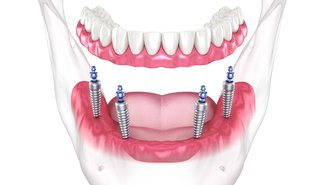
All-on-4 is a full-arch dental implant technique that replaces all upper or lower teeth using four titanium implant posts surgically placed in the jawbone. Two implants are positioned vertically toward the front of the jaw, and two are placed at an angle of up to 45 degrees toward the back. This angled placement is the key clinical innovation: it allows the posterior implants to anchor into the denser bone at the back of the jaw, distributing biting forces across the entire arch and, in most cases, eliminating the need for bone grafting.
Once the implants are in place, a custom-made full-arch prosthesis (a complete bridge of teeth) is attached to them. Unlike removable dentures, this prosthesis is fixed and cannot be taken out by the patient. It is designed to restore near-natural chewing function, clear speech, and a natural appearance.
The term "Teeth in a Day" refers to the fact that in most cases, a temporary prosthesis is attached on the same day as implant surgery, allowing patients to leave the clinic with a complete set of functioning teeth. The final permanent prosthesis, typically made from zirconia or high-grade acrylic, replaces the temporary one after the implants have fully integrated with the jawbone (3 to 6 months). At Skymark Smile Centre, this procedure is offered under the All-on-X dental implants approach, which means the number of implants (4, 5, 6, or more) is customized to each patient's anatomy rather than fixed at four.
How Does the All-on-4 Procedure Work?
Understanding the step-by-step process helps patients know exactly what they are committing to and what "Teeth in a Day" actually means in practice.
Step 1: Consultation and 3D Imaging
The process begins with a comprehensive clinical examination and a CBCT (cone beam computed tomography) scan, a 3D X-ray that reveals jawbone structure, bone density, nerve locations, and sinus anatomy in detail. This imaging is essential for precise implant planning. At Skymark Smile Centre, the team uses a fully digital workflow: CBCT scanning, 3D treatment planning, and in some cases, 3D-printed surgical guides and provisional prostheses for maximum precision and efficiency.
Step 2: Digital Treatment Planning
Using the 3D scan data, the exact position and angle of each implant is planned digitally before surgery begins. This pre-surgical planning determines how the angled posterior implants will be positioned to avoid nerve canals, maximize bone contact, and achieve optimal load distribution across the arch.
Step 3: Surgery Day, Implant Placement, and Temporary Teeth
The surgical appointment typically takes 2 to 4 hours per arch. Under local anesthesia and dental sedation (oral, IV, or general anesthesia depending on patient preference), any remaining teeth are extracted, and the four implants are placed according to the pre-surgical plan. A temporary full-arch prosthesis is then attached on the same day. You leave the clinic with a complete set of functioning teeth.
Step 4: Healing and Osseointegration (3 to 6 Months)
Osseointegration is the biological process by which bone cells grow directly onto the titanium implant surface, creating a permanent bond between the implant and the jawbone. During this period, patients attend regular check-up appointments to monitor healing, implant stability, and gum health. A soft diet is recommended for the first several weeks to protect the healing implants.
Step 5: Final Prosthesis Placement
Once the implants have fully integrated (as confirmed by clinical assessment and imaging), the temporary prosthesis is replaced with the final permanent bridge. This is the completed restoration: a fixed, non-removable arch of teeth that looks, feels, and functions like natural teeth. The final prosthesis is custom-designed in a dental laboratory to match the patient's facial structure, gum line, and desired aesthetic.
"Our digital workflow allows us to plan every case digitally before we enter the operating room. We use CBCT, 3D scanning, and in many cases 3D-printed provisionals, which means less time in surgery, more precision in implant placement, and better outcomes for the patient." — Dr. Amir Guorgui, BSc, DMD, MACSD — Lead Dentist, Skymark Smile Centre
All-on-4 vs. Traditional Implants vs. Dentures
Patients considering full-arch tooth replacement typically weigh three options. The following table provides a clinical and practical comparison.
| Factor | All-on-4 Implants | Traditional Individual Implants | Removable Dentures |
|---|---|---|---|
| Number of implants | 4 per arch | 6–10+ per arch | None |
| Bone grafting | Rarely needed | Often required | Not applicable |
| Treatment timeline | Teeth same day; final 3–6 months | 6–12+ months | Weeks |
| Chewing efficiency | Near-natural biting force | Near-natural | ~20–25% of natural |
| Bone preservation | Yes (implants stimulate bone) | Yes | No (bone loss continues) |
| Stability | Fixed, non-removable | Fixed, non-removable | Removable; may slip |
| Longevity | Decades with proper care | Decades with proper care | Replace every 5–7 years |
| Approximate cost/arch | $20,000–$35,000 | $40,000–$80,000+ | $1,500–$4,000 |
| Long-term cost | Lower (fewer replacements) | Lower (fewer replacements) | Higher (ongoing relining, replacement) |
The upfront cost difference between All-on-4 and removable dentures is significant. However, dentures provide no stimulation to the jawbone. Without that stimulation, bone resorption continues to change the shape of the jaw, affect facial volume, and cause dentures to fit progressively worse over time. All-on-4 implants address this directly: once integrated, they function as artificial tooth roots, delivering the mechanical loading the jawbone needs to maintain its density.
How Much Do All-on-4 Dental Implants Cost in Ontario?
In Ontario, All-on-4 treatment typically costs between $20,000 and $35,000 CAD per arch. The exact figure depends on the prosthesis material (acrylic vs. zirconia), case complexity, and whether additional procedures such as extractions or bone grafting are needed. Because All-on-4 is a multi-stage treatment that combines surgery, implants, and prosthetic fabrication, there is no single standard fee. The cost ranges below reflect current pricing across Ontario dental practices as of 2026.
| Treatment | Approximate Cost Range (Ontario, 2026) |
|---|---|
| All-on-4, one arch (acrylic prosthesis) | $20,000 – $26,000 |
| All-on-4, one arch (zirconia prosthesis) | $25,000 – $35,000 |
| All-on-6, one arch | $28,000 – $35,000+ |
| Full mouth, both arches (All-on-4) | $40,000 – $60,000+ |
| Traditional individual implants (full arch) | $40,000 – $80,000+ |
| Removable dentures (one arch) | $1,500 – $4,000 |
What Is Included in the Price vs. What Costs Extra
One of the most common sources of confusion in All-on-4 pricing is what the quoted number actually covers. Advertised prices do not always include every component of treatment. Before committing to any clinic, request an itemized treatment plan. A complete All-on-4 quote should include:
| Typically Included in the Price | Often Quoted Separately |
|---|---|
| CBCT 3D imaging and treatment planning | Extraction of remaining teeth ($150–$600/tooth) |
| Four titanium implant posts | Bone grafting or sinus lift ($2,000–$8,000) |
| Abutments (implant-to-prosthesis connectors) | IV sedation or general anesthesia ($500–$2,000) |
| Temporary prosthesis (placed same day) | Additional follow-up visits beyond standard |
| Final permanent prosthesis | Night guard (recommended for bruxism patients) |
| Standard post-surgical follow-up appointments | Temporary prosthesis repairs (if needed during healing) |
At Skymark Smile Centre, a full written cost estimate is provided after your consultation and CBCT imaging. If extractions, bone grafting, or sedation are anticipated based on your imaging, those costs are identified upfront rather than after surgery.
Insurance, CDCP, and Financing
Most standard dental insurance plans in Ontario do not cover dental implants, including All-on-4. Implants are typically classified as elective treatment. However, some premium plans may offer partial reimbursement for prosthetic components (such as the bridge or crown portion). If you have coverage, submit a pre-treatment estimate to your insurance provider before proceeding.
The Canadian Dental Care Plan (CDCP) has limited coverage for implant procedures as of 2026. The plan primarily covers essential oral health services rather than full surgical implant treatment. Patients should confirm their specific eligibility with a registered CDCP provider.
For patients without insurance coverage for implant treatment, Skymark Smile Centre offers flexible payment options that spread the cost over several months. Phased treatment (completing one arch first, then the second at a later date) is also an option for managing costs in stages.
What Does Recovery After All-on-4 Look Like?
Recovery from All-on-4 surgery is more manageable than many patients expect. Here is what to anticipate at each stage.
First 24 to 72 Hours
Swelling, mild bruising, and discomfort are normal and peak around day 2 to 3. Pain is typically managed with prescribed medication and over-the-counter anti-inflammatories. A liquid and very soft food diet (smoothies, yogurt, soups, scrambled eggs) is recommended. Most patients can return to desk-based work within 2 to 3 days.
Week 1 to Week 4
Swelling gradually subsides. Patients transition from a liquid diet to soft foods (such as pasta, fish, cooked vegetables, and soft bread). The temporary prosthesis is functional but should not be stressed with hard, crunchy, or sticky foods. Oral hygiene involves gentle brushing with a soft-bristle toothbrush and rinsing with a prescribed antibacterial mouthwash.
Month 2 to Month 6
Osseointegration progresses during this period. Patients gradually expand their diet as comfort improves. Regular check-up appointments monitor implant stability and healing. By months 3 to 6, the implants are fully integrated and ready for the final prosthesis.
Long-Term Maintenance
After final prosthesis placement, maintenance is similar to caring for natural teeth: brush twice daily, use a water flosser to clean beneath the prosthetic bridge, and schedule professional cleanings every 6 months. There is no need for adhesives, soaking, or overnight removal. A night guard is recommended for patients with a history of teeth grinding.
Temporary vs. Permanent Prosthesis: What to Expect at Each Stage
This is one of the most common questions patients ask, and the distinction is important for setting expectations.
The temporary prosthesis is placed on the same day as surgery. It is typically made from acrylic and is designed for light function during the healing period. It allows you to eat soft foods, speak normally, and smile with confidence while the implants integrate with the jawbone. However, it is not as strong, as aesthetically pleasing, or as precisely fitted as the final prosthesis. Think of it as a functional placeholder.
The final permanent prosthesis replaces the temporary one after 3 to 6 months, once osseointegration is confirmed. It is custom-fabricated in a dental laboratory from higher-grade materials, typically monolithic zirconia (for maximum strength and aesthetics) or premium acrylic. The final prosthesis is precisely fitted to your gum line, bite, and facial structure. It is designed to last decades and provides near-natural chewing force, speech clarity, and appearance.
| Feature | Temporary Prosthesis | Final Permanent Prosthesis |
|---|---|---|
| Placed when | Same day as surgery | After 3–6 months of healing |
| Material | Acrylic | Zirconia or premium acrylic |
| Strength | Light function only | Full chewing force |
| Aesthetics | Functional (not custom-matched) | Custom-designed to match facial structure |
| Diet restrictions | Soft foods only | Unrestricted with proper care |
| Lifespan | 3–6 months (temporary) | Decades with maintenance |
Who Is a Good Candidate for All-on-4?
You may be a strong candidate for All-on-4 dental implants if you meet one or more of the following criteria:
- Missing all or most teeth in one or both arches, or have teeth that are failing and need to be extracted.
- Currently wearing removable dentures and experiencing frustration with fit, stability, or comfort.
- Adequate jawbone density to anchor the implants. One of the key advantages of the All-on-4 technique is that the angled posterior implants are designed to reach denser bone, allowing many patients with moderate bone loss to qualify without bone grafting. In cases of severe bone loss, additional procedures (grafting or zygomatic implants) may be needed.
- Good general health and medical fitness for oral surgery. Conditions such as uncontrolled diabetes, active cancer treatment, or medications affecting bone metabolism require individual assessment but are not automatic disqualifiers.
- Non-smoker or willingness to quit. Smoking significantly increases the risk of implant failure. Most clinicians require patients to stop smoking before and during the healing period.
- Commitment to oral hygiene and follow-up appointments. Long-term success depends on maintaining proper cleaning routines around the implant-supported prosthesis.
"For patients who have been living with loose dentures or a mouth full of failing teeth, All-on-4 is genuinely life-changing. The ability to walk in with a problem that has been affecting their daily life for years and walk out the same day with a full set of stable, functioning teeth is something that never gets old to see." — Dr. Robert Eisen, DDS — General Dentist & Founder at Skymark Smile Centre
All-on-4 Dental Implants at Skymark Smile Centre in Mississauga
Skymark Smile Centre has been providing dental implant and full-arch restoration services in Mississauga for over 25 years. Our implant team, led by Dr. Amir Guorgui and Dr. Robert Eisen, has placed thousands of implants across the full spectrum of complexity, from single-tooth replacements to full-mouth All-on-X reconstructions. We use a fully digital workflow including CBCT imaging, 3D treatment planning, and computer-guided implant placement to maximize precision and minimize surgical time.
Our practice offers a full range of sedation options, from nitrous oxide to IV sedation to general anesthesia, so that every patient can undergo treatment in comfort. We also provide flexible financing and phased treatment options to help make full-arch implant treatment accessible.
If you are considering All-on-4 or any full-arch implant solution, the first step is a consultation with 3D imaging. We will evaluate your anatomy, discuss your options, and provide a clear written cost estimate with no hidden fees.
Book a free consultation to find out whether All-on-4 is right for you.
Making the Right Decision About Full-Arch Dental Implants
All-on-4 dental implants represent a proven, well-documented solution for patients who have lost all or most of their teeth, or whose remaining teeth can no longer be saved. The procedure combines the stability of dental implants with the efficiency of a four-implant design to deliver a full arch of fixed, natural-looking teeth, often in a single day.
The investment is significant, but so is the return: restored chewing ability, preserved jawbone, natural speech, and the confidence that comes from a stable, permanent smile. When the long-term costs of alternatives like dentures are factored in, along with available tax credits and financing options, All-on-4 often represents the most practical long-term solution for full-arch tooth replacement.
The right first step is always a thorough consultation with a qualified implant team that can evaluate your specific anatomy, explain your options clearly, and give you a transparent cost estimate before any commitment is required.
Frequently Asked Questions
How long do All-on-4 dental implants last?
The titanium implant posts are designed to last a lifetime with proper care. The prosthetic bridge attached to them typically lasts 15 to 25 years or longer, depending on the material (zirconia lasts longer than acrylic) and the patient's oral hygiene and maintenance habits.
Is the All-on-4 procedure painful?
The procedure is performed under local anesthesia with sedation options ranging from oral sedation to IV sedation to general anesthesia. Most patients report minimal discomfort during the procedure itself. Post-surgical soreness and swelling are managed with prescribed medication and typically peak at day 2 to 3, resolving within 1 to 2 weeks.
How long is the recovery period?
Most patients can return to desk-based work within 2 to 3 days. A soft diet is recommended for the first 4 to 6 weeks. Full recovery (osseointegration) takes 3 to 6 months, after which the final permanent prosthesis is placed. During healing, patients function normally with the temporary prosthesis.
Can smokers get All-on-4 implants?
Smoking significantly increases the risk of implant failure by impeding blood flow to the surgical site and slowing osseointegration. Most clinicians strongly recommend quitting smoking at least 2 weeks before surgery and throughout the healing period. Smoking is not an automatic disqualifier, but it increases risk and may affect long-term outcomes.
Are All-on-4 implants covered by insurance or the CDCP?
Most standard dental insurance plans do not cover implant procedures. Some premium plans may partially reimburse the cost of prosthetic components. The CDCP has limited implant coverage as of 2026. All-on-4 treatment does qualify as a medical expense for the Canadian federal medical expense tax credit (15%), which can offset a meaningful portion of the cost.
What is the difference between All-on-4, All-on-6, and All-on-X?
All-on-4 uses four implants per arch to support a full bridge of teeth. All-on-6 uses six implants to provide additional load distribution and stability, and is typically recommended for patients with high bone density and higher functional demands. All-on-X is the umbrella term used at practices like Skymark Smile Centre to describe a customized approach: the number of implants (4, 5, 6, or more) is determined by the patient's specific anatomy, bone density, and clinical needs rather than fixed at a predetermined number. This allows the treatment plan to be optimized for each individual case.
Can I get All-on-4 with bone loss?
Many patients with moderate bone loss qualify for All-on-4 without bone grafting. The angled posterior implants are specifically designed to reach denser bone at the back of the jaw, bypassing areas of bone loss. In cases of severe bone loss, additional procedures such as bone grafting, zygomatic implants, or a modified implant configuration may be needed. A CBCT scan at your consultation will determine your eligibility.